
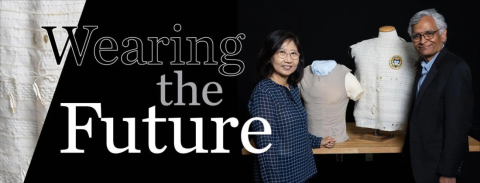
If you walked through the Smithsonian American History Museum in the mid-2000s, you might have seen the “Smart Shirt,” the very first garment to seamlessly combine textiles and electronics.
Dubbed a “wearable motherboard,” it acted as a hub for sensors that could collect a range of biometric data.
That shirt foretold a future where health and biometric data could be collected unobtrusively through wearable technology. And it was created by engineers at Georgia Tech.
“What we have is all these nice data buses that are the fabric threads. And we can connect any kind of sensors to them,” said Professor Sundaresan Jayaraman, the shirt’s co-creator. “We were able to route information in a fabric for the first time, just like a typical computer motherboard. That’s why we called it the ‘wearable motherboard.’”
Jayaraman and Sungmee Park created the shirt in response to a Defense Advanced Research Projects Agency (DARPA) call for ideas to protect soldiers in battle. They envisioned a comfortable, flexible garment infused with fiber optics to detect gunshot wounds and vital signs. The data would help medics rapidly triage battlefield injuries in the critical minutes when emergency care is the difference between life and death.
Creating a shirt made it easy: no bulky electronics to add to the gear soldiers carried. Just a piece of clothing to wear under their fatigues. Park and Jayaraman developed a way to weave the garment on a loom, making mass production and consistency far easier.
The original sleeveless shirt is tucked into the Smithsonian archives now. But it’s possible to follow the thread of that first smart textile to the work happening in the pair’s School of Materials Science and Engineering (MSE) lab today.
Read the full story on Georgia Tech's College of Engineering website.