
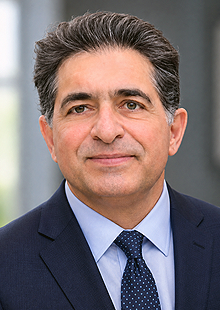
After more than two decades of teaching materials characterization at Georgia Tech, Professor Hamid Garmestani has transformed years of classroom experience into a new textbook designed to help students better understand how scientists study and analyze materials.
Fundamentals of Microstructural Characterization of Materials, published by Springer, grew out of Garmestani's work teaching MSE 2021, a core course in materials characterization that he has taught since 2001.
"The book grew out of teaching MSE 2021 at Georgia Tech for more than 20 years," Garmestani said. "For many years, students struggled because there wasn't a comprehensive textbook that covered the material clearly and cohesively."
To address that challenge, Garmestani began developing and refining his own lecture notes based on classroom experience and student feedback. About six years ago, he decided the material had matured enough to become a textbook. Working with one of his doctoral students, he expanded those notes into a nearly 500-page resource that includes homework problems, quizzes, laboratory experiments, and other instructional materials.
The book addresses a longstanding gap in materials science education. MSE 2021 combines several disciplines, including X-ray diffraction, optical microscopy, electron microscopy, and stereology. Traditionally, students relied on multiple textbooks, each covering a different aspect of the course.
"The biggest gap was the absence of a single textbook that covered the full scope of the course," Garmestani said. "Using several separate books made it difficult for students to see the connections between the different characterization techniques."
By bringing these topics together in one volume, the textbook provides an integrated framework for understanding how characterization methods complement one another.
Designed primarily for undergraduate and early graduate students, the book emphasizes both accessibility and practical application. Alongside explanations of theory, it includes worked examples, illustrations, laboratory exercises, quizzes, and assignments that instructors can readily incorporate into their courses.
"My goal was to create a resource that is equally valuable for both students learning the material and faculty members teaching it," Garmestani said.
One of the book's distinguishing features is its focus on the scientific principles underlying characterization techniques. Rather than presenting methods as isolated tools, Garmestani begins with concepts such as wave behavior and electronic structure before examining how electrons, X-rays, and neutrons are generated and interact with materials.
"I wanted students to understand not only how to use these techniques, but also why they work," Garmestani said.
That approach reflects his broader teaching philosophy.
"My teaching philosophy has always been to emphasize fundamental principles before introducing applications," Garmestani said. "Once students understand the underlying physics, they are much better prepared to interpret experimental results and solve real engineering problems."
The textbook uses illustrations, examples, and real-world applications to help students understand concepts that can initially seem abstract, including diffraction, electron scattering, wave-particle interactions, and image formation.
While developed for materials characterization courses, Garmestani believes students in physics, chemistry, biology, and related fields can also benefit from its treatment of analytical and imaging techniques. He also sees the book as helping students connect classroom concepts to the tools used in research and industry, where techniques such as optical microscopy, scanning electron microscopy, and X-ray diffraction play important roles across sectors ranging from aerospace and energy to electronics and biomedical engineering.
"By understanding the fundamental physics behind these methods, students will be better equipped to analyze materials, interpret experimental data, and contribute to both research and industrial applications," Garmestani said.
Already, the response from students and faculty has been encouraging. Even before publication, students requested copies of the manuscript and faculty members at other institutions asked to review chapters.
Ultimately, Garmestani hopes the book will become a widely adopted resource for both educators and students.
"Because it was developed and refined through more than 20 years of classroom teaching, it reflects the questions students ask, the concepts they find most challenging, and the laboratory experiences that help them learn most effectively," he said. "I hope the book helps educate the next generation of materials scientists and engineers while also providing instructors with a complete set of teaching resources."