
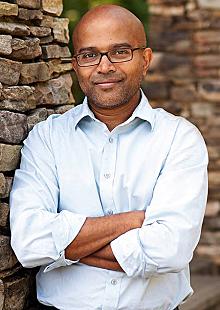
Another school year is here, and as students make their way onto campus, things can start to feel repetitive: class, labs, research, and exams. However, School of Materials Science and Engineering (MSE) Professor Faisal Alamgir has taken a unique approach to his teaching style. He has combined science with theater, creating an innovative approach to learning.
Alamgir focuses on teaching the atomic-scale fundamentals of structure-property relations and on materials characterization. While equations and technical concepts remain central to his courses, Alamgir challenges students to engage with the information unexpectedly— transforming scientific discoveries into dramatic performances.
The idea emerged from a collaboration with a colleague in Georgia Tech's School of Literature, Media, and Communication. Alamgir was exploring narrative approaches to teaching and looking for ways to help students move beyond viewing equations as fixed truths handed down by experts. Instead, he wanted students to understand that every equation represents years of scientific investigation, debate, experimentation, and discovery. "I wanted them to understand that an equation is a summary of knowledge," Alamgir said. "There was knowledge before the knowledge and that there is always a process by which new knowledge is created."
Over the course of a semester, student teams research the history behind a scientific equation, learning about the scientists who developed it, the competing ideas that existed before it, and the challenges involved in establishing new knowledge. They then translate their findings into a short theatrical production, complete with scripts, props, and performances. DramaTech supports the process through collaboration, with its director helping students develop and refine their scripts before they take the stage.
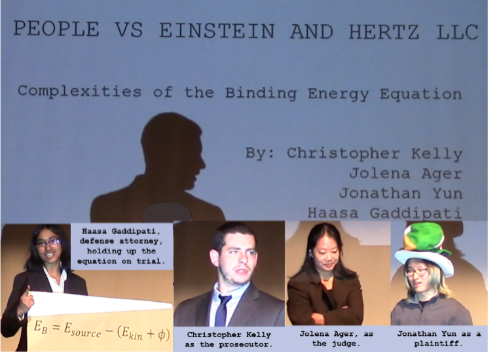
One of Alamgir's favorite examples involved Albert Einstein's work on the photoelectric effect, a concept that remains important in materials characterization. Rather than giving a traditional presentation, students reimagined the science as a courtroom drama. In the skit, called “People vs. Einstein and Hertz LLC”, a fictional company founded by Einstein faced a class-action lawsuit from customers who claimed the practical realities of the technology were more complicated than advertised (the image shows a flyer for the skit with the roles that each student played).
“The idea is based on the photoelectric effect discovered by Albert Einstein and Heinrich Hertz. In the skit, the students imagined that the equation for the photoelectric effect was used by Einstein and Hertz to establish a company, Einstein and Hetrz LLC, and commercialize an instrument that purported to characterize materials. However, the customers who used the instrument found that the equation for the photoelectric effect was too simplistic and hid all the pitfalls of using it for materials characterization. So, the disgruntled customers filed a class action law suit against Einstein and Hertz LLC for false advertising.” Through witness testimony and legal arguments, the students explored both the scientific theory and the challenges of applying it in real-world settings.
The exercises not only help students see scientists as people rather than untouchable geniuses, but the performances also encourage students to internalize concepts in ways that go beyond memorization. According to Alamgir, standing in front of an audience and communicating ideas through dialogue, movement, and storytelling helps students develop a stronger connection to the material. Many students report that the experience makes them more confident learners and gives them a greater appreciation for the complexity of scientific discovery. Multiple students have said in their reflection they will never forget the their project equation because of all their efforts in researching, discussing, writing, and performing. Alamgir calls this “a fully internalized” learning process.
Alamgir's approach is intended to build confidence, historical and critical awareness, collaboration skills, and a lifelong habit of reverse-engineering knowledge instead of passively accepting it. By encouraging students to investigate how scientific understanding develops, he hopes they become more active participants in their own learning.
"They should not be passive in the learning of knowledge," Alamgir said. "They need to be able to ask questions and not take things for granted."
Long after students leave his classroom, Alamgir hopes they carry that mindset with them. Whether they are conducting research, solving engineering challenges, or encountering new ideas, he wants them to approach knowledge with curiosity, skepticism, and a willingness to explore the process behind the answer. For him, the dramatic retellings are not simply creative assignments. They are opportunities for students to understand that science is a human endeavor, shaped by questions, collaboration, and discovery.